A few nice german celebrities images I found:
Tacheles stairs, Berlin 
Image by Paolo Margari Join my page on Facebook Berlin, Germany 2010 HDR Storia del Tacheles Il centro commerciale Friedrichstraßepassage, conosciuto come “la cattedrale del consumoâ€, fu costruito tra il 1907 e il 1909. Era il secondo centro commerciale di Berlino e una delle prime costruzioni in cemento armato. La facciata contiene elementi di stile gotico e neoclassico. In mezzo al passaggio si può ammirare una delle piú grandi cupole in cemento armato di Europa. Tanto la tecnica quanto il disegno architettonico dell’edificio sono espressioni dell’inizio dell’era moderna. Nel 1928 la compagnia di strumenti elettronici AEG entrò in possesso dell’edificio elo utilizzò come “Casa della Tecnologia†per esposizioni e presentazioni commerciali, ma anche cinematografiche. Nel 1936 vi furono trasmessi televisivamente i giochi olimpici, per la prima volta al mondo. Dopo il 1933 i vari spazi dell’edificio cominciarono ad essere utilizzati da varie organizzazioni connesse al nazismo. L’unione dei lavoratori tedeschi DAF, controllata dai nazisti, prese in gestione l’edificio nel 1941, per stabilirvi una sede SS. Nel 1943 dei prigionieri francesi furonorinchiusi provvisoriamente nell’attico. Con la fondazione della GDR nel 1949 l’edificio fu trasferito in proprietà della trade union FDGB, facente parte della Germania dell’Est. In seguito alla Separazione della Germania e di Berlino, la costruzione rimase vuota salvo che per usi a breve termine, come per l’armata NVA o per la Scuola circense, e comincio ad andare in rovina.Nonostante che il Friedrichpassage fosse stato distrutto soltanto parzialmente durante la Seconda Guerra Mondiale, due ispezioni ufficiali, l’una del 1969, l’altra del 1977, ne raccomandarono la demolizione. All’inizio degli anni Ottanta alcune parti del complesso furono effettivamente demolite. Grazie a un sotterraneo di due piani, costruito come sostegno nel 1923-24, l’ala ancora oggi esistente sopravvisse. Dopo la caduta del muro nel 1989 a Berlino Est sorse un movimento “squatterâ€. In particolare nei quartieri centrali Mitte, Prenzlauer Berg e Friedrichshain tale subcultura occupò il vuoto creato dalla scomparsa della GDR . La demolizione finale dell’edificio, prevista per aprile1990, fu evitata grazie all’occupazione promossa dal Gruppo di artisti Tacheles. Grazie al sostegno delle pubbliche istituzioni la sopravvivenza dell’edificio fu poi ulteriormente garantita, e, dopo un’ulteriore ispezione, l’edificio fu considerato parte del Patrimonio monumentale nazionale. Nel 1998 la compagnia di investimenti FUNDUS ha comprato l’edificio sotto la condizione che il Tacheles potesse continuare ad esistere quale luogo storico e culturale. Fu stabilito di conseguenza un affitto simbolico di un marco tedesco al mese. Nel 2000-02 la costruzione fu restaurata, seguendo una procedura architettonica che ha posto in contrasto lo stile decadente delle rovine con elementi contemporanei e tecnologici. La Art House Tacheles è ancora oggi un luogo di incontro internazionale, vòlto alla promozione e allo scambio di nuove concezioni artistiche e culturali. Oltre al teatro, al cinema e ai bar, uno degli elementi di base dell’attività del Tacheles è la messa a disposizione di numerosi spazi nella forma di ateliers per giovani artisti provenienti da tutto il mondo. --- The History of TACHELES “Tacheles†is an old Jewish word meaning to disclose, to reveal or to speak clearly. The slang meaning of the word was bringing to an end. The Art-Centre Tacheles is situated in a ruin in Berlin Mitte. Located in former East Berlin, the area was a Jewish quarter in the past and has now become a meeting point for people interested in arts and culture and for those who think they are. The building itself was the entrance of the Friedrichstadt-Passage, a huge shopping mall built in 1907. Within a relatively short time, the department store went bankrupt, and in 1928 the house was taken over by AEG, that founded the Haus der Technik, a display and marketing space for their products. In Word War II parts of the building were used by the Nazi Party for administration and organization departments, and in the 5th floor French prisoners of war were detained. Between 1943 and 1945 during the allied air raids the building was hit by bombs several times and got partly damaged, but not completely destroyed. After 1948, one side of the building was still used for many different purposes, but the other side was slowly torn down, step-by-step, as the East Berlin government had no funds to restore it properly and for the distant future they had other plans for this area. So meanwhile, the house became just a storage for building material. The very last structure still standing was planned to be demolished in April 1990. In Febuary 1990 the building was discovered and taken over by a group of young artists from all over the world and in the meantime it has been declared a historical architectural monument, regarding its special steel construction. After the Berlin Wall came down in November 1989, a subculture which had its main focus on autonomy, spontaneity and improvisation arose in the former East Berlin areas Mitte, Prenzlauer Berg and Friedrichshain. Artists and individualists from all over the world used the plurality of available free spaces to put alternative lifestyles to the test. Due to the individualistic character of the building and the mass of creative activities taking place, the Tacheles soon became famous. Right from the start, Tacheles was a centre of development and realization of individual ways of thinking, of the creative contamination of art and living as well as the testing of artistically and urban ideas. Many international artists staged performances or concerts here, exhibited paintings, sculptures and installations. This essential thought still exists today and the program was even extended further by staging and organizing performances, theatre, various workshops, poetry and special events. During its existence, Tacheles in its function as an international arts centre has greatly influenced and formed the surrounding area in a positive as well as in a negative sense. By now the once creative surrounding area has mutated to a napless trend quarter. Tacheles also attained recognition from the Berlin government and receives a varying amount of subsidy every year in order to help finance a part of its many projects. Other money is raised through commercial enterprises such as the cinema and the bar. Because of its special architecture and the “ruin appearance†of the rearside and due to its 13 years of activities in the international arts field, “Kunsthaus Tacheles†became quite a celebrity on a national and international scale and is also listed in many travel guides of Berlin. In the course of changes since the wall came down, Tacheles has been confronted with the difficult challenge of remaining true to its roots and ideals without becoming too sentimental about the old squatter times. source: super.tacheles.de
Bill Kaulitz 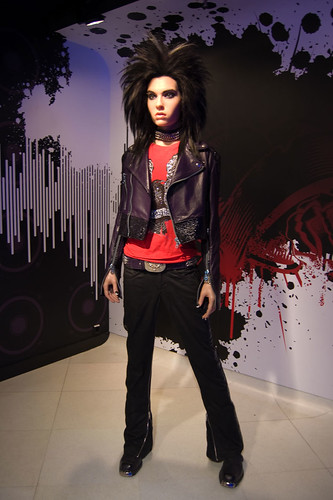
Image by Sebastian Niedlich (Grabthar) I could almost hear the screams of thousands of girls in puberty. Bill Kaulitz is the singer of Tokio Hotel, a German band that is apparently also pretty successful overseas. Part of the Madame Tussauds Berlin set.